


Being In Your Head Isn't The Problem
Updated: Apr 28
One of the most common notes I hear from students in class is a form of:
“I need to get out of my head.”
But here’s what I know after years of doing this:
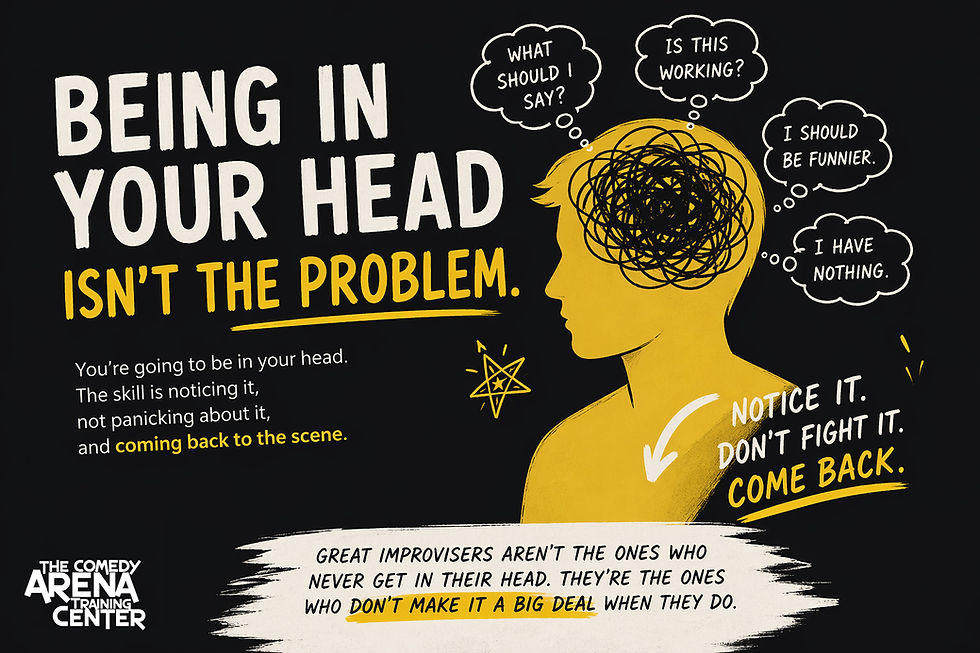
You’re not going to get out of your head.
Not completely. Not permanently. Not even on your best day.
So if that’s the goal, you’re chasing something that doesn’t really exist and you’re probably being way harder on yourself than you need to be.
I Still Do It Too
I still get in my head all the time.
In shows. In scenes I care about. In moments where my brain goes:
“What’s the move here?”
“Is this landing?”
“Do I have anything?”
That doesn’t magically go away just because you’ve done more improv. At the end of the when you're improvising, you're acting, writing, editing, directing, you're playing all the parts so how can you not be in your head?
So when I see it happen in class, I’m not thinking,“Ah, they’re stuck in their head.”
I’m thinking,“Yep. That’s part of the process.”
The Thing That Actually Messes You Up
Being in your head isn’t what throws you off.
It’s what you do after you notice that you're in your head.
Here’s the pattern I see all the time:
A player realizes they're in their head → they think they shouldn’t be → they start to panic → now they're completely gone
Now it’s not just a quick thought.
Now it’s:
judging yourself
trying to fix it
scrambling for something “better”
And suddenly they’re nowhere near the scene anymore.
The Shift I Want for You
I’m not trying to train you to be thoughtless.
I’m not trying to get you into some perfect, zen, always-present state.
What I actually want is much simpler:
I want you to be cool with it.
When you notice you’re in your head, I want your reaction to be:
“Oh. There I am.”
Not:
“Oh no. I’m messing this up.”
Because that tiny shift?
That’s what gets you back.
The Skill Isn’t Avoiding It. It’s Recovering
Being In Your Head Isn't a Problem in Improv. The best improvisers I know still have thoughts mid-scene.
They just don’t turn it into a whole situation.
They notice it, and then:
they look at their partner
they listen again
they make a simple move
They don’t wait to feel inspired.
They don’t pause the scene while they figure it out.
They just rejoin the moment.
What This Looks Like in Real Time
You’re in a scene and suddenly think:
“I have no idea what this is.”
Cool. Totally normal.
Instead of spiraling into:
“I should know”
“I’m behind”
“I need something good”
Try this:
notice the thought
don’t argue with it
look back at your partner
respond to what’s actually happening
That’s it.
No big reset. No apology. No panic.
Just… continue. Just ask yourself, "what comes next?"
Let Me Be Clear About One Thing
This is not permission to hang out in your head all scene.
If you stay there planning, judging, trying to be clever, you will still disconnect.
But there’s a big difference between:
briefly visiting your head
and
moving in and paying rent (although I get some things live in your head rent free)
A misconcomption is Improv asking you not to think.
It's actually asking you to not get stuck thinking.
A Couple Things You Can Practice
If you want to build this as a skill, here are a few simple things I use in class:
1. “Name it, don’t fight it.”When you notice you’re in your head, just internally go:
“Thinking.”And then come back to your partner. No judgment attached.
2. Default to the obvious. When your brain locks up, don’t search for something brilliant. Say the next honest or obvious thing. That will keep you in the scene way more than waiting.
3. Reconnect physically. If you feel yourself drifting, literally turn your body toward your scene partner, make eye contact, and listen.Your body can get you back faster than your brain.
What I Hope You Remember
You are going to be in your head sometimes.
In class. In shows. In scenes that are working and scenes that aren’t.
That’s not the issue.
The issue is when you decide that it means something is wrong.
Because the moment you stop treating it like a problem…
you get back to playing a whole lot faster.
And at the end of the day, that’s the goal.
Not perfection.
Just staying in it.


Comments