


Should You Listen to Comedy Podcasts While Taking Improv Classes?

There’s never been a better time to learn comedy.
You can listen to podcasts, watch clips, read books and attend shows. There’s so much great insight out there from really smart, experienced performers.
And I love that.
It's what I seriously want for our students. To be curious and to explore things outside of class.
But there’s something I’ve noticed over the years, and it’s worth talking about:
Not everything you learn outside the classroom fits neatly into what’s happening inside it.
The Good Stuff (Because There Is a Lot of It)
Listening to comedy podcasts or diving into outside material can be incredibly helpful.
Sometimes you hear something explained in a totally different way and it finally clicks. Sometimes it inspires you. Sometimes it just gets you excited to get back on stage.
All of that is great. We want that!
Where Things Can Get Weird
The issues don’t come from learning more. They come from how it shows up in class.
And I’ve seen this happen a lot.
1. Not Everyone Is Listening to the Same Podcast as You
In class, we’re all (ideally) building from the same foundation.
Then someone brings in a concept from a podcast, or starts using different terminology, or plays scenes based on a different philosophy…
…and suddenly we’re not quite on the same page anymore.
No one’s wrong. But we’re not aligned.
And improv works best when everyone is speaking the same language.
2. You Can Accidentally Skip Steps
Every class is designed to build on itself.
And I get it. You hear something advanced or interesting and you want to try it immediately.
But sometimes that ends up pulling you out of the exercise instead of helping you grow.
I’ve had students try to “jump ahead” conceptually, and it actually slows them down because they’re not fully locking in the fundamentals yet.
There’s a lot of value in just being where you are.
3. Not All Advice Applies Everywhere
A podcast host might be:
a 20-year veteran
trained in a completely different style
working in a totally different environment
So when they say, “This is how it works,” what they really mean is:
“This is how it works for me, here, in this context.”
That doesn’t make it wrong.
But it also doesn’t automatically make it right for you right now.
4. It Can Mess With Your Head a Little
You start listening to a lot of outside content and suddenly you feel like:
“I should be better than I am”
“I should already know this”
“Am I doing this wrong?”
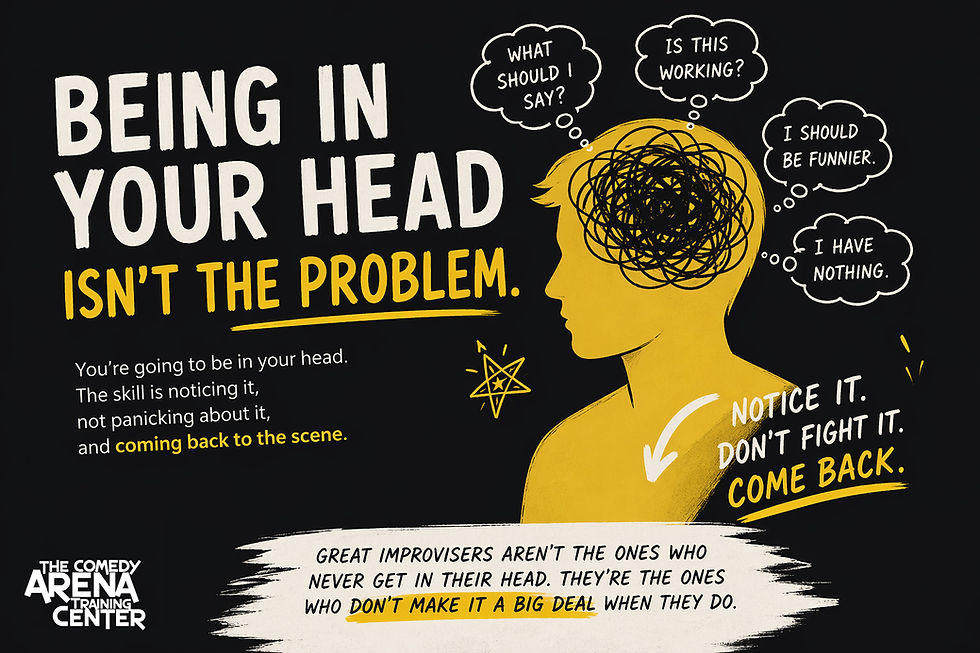
And now instead of playing, you’re thinking.
And instead of being present, you’re evaluating yourself.
That’s not where we want you.
So What Should You Do?
I’m not telling you to stop listening to podcasts.
Not at all.
I’m just saying:
Use them as a supplement. Not a substitute for what you’re doing in class.
Stay curious. Take things in. But run it through a filter.
A Simple Filter
When you hear something new, ask yourself:
“Is this helpful for where I am right now?”
If yes, awesome! Try it! If not, hold onto it. You’ll come back to it later.
Because you will.
My Final Thought
The best improvisers I’ve seen aren’t the ones who know the most theory (though I love talking theory).
They’re the ones who:
show up
listen
support their teammates
and trust the process
Everything we’re doing in class is intentional. So go explore, learn, and get inspired. I love that. Just don’t lose sight of the work right in front of you.
That’s where the real growth happens.


Comments